
Market Review – February 2026

Key Themes:
- Australian equities rose and international equities were mixed in February: Australian equities grew on the back of strong commodity prices and solid earnings reports from major banks while international equities experienced some rotation out of the Magnificent Seven.
- Domestic and international bonds rose: Both Australian and international bond prices rose as geopolitical tensions and economic uncertainty increased demand for defensive assets.
- Australian dollar strengthened: The Australian dollar continued to be supported by strong commodity prices and a weakening US dollar.
- The prices of oil and gold grew: Both gold and oil prices were supported by geopolitical tensions and other factors such as the supply for oil and central bank demand for gold.
How the different asset classes have fared
(As at 28th February)
International Equities
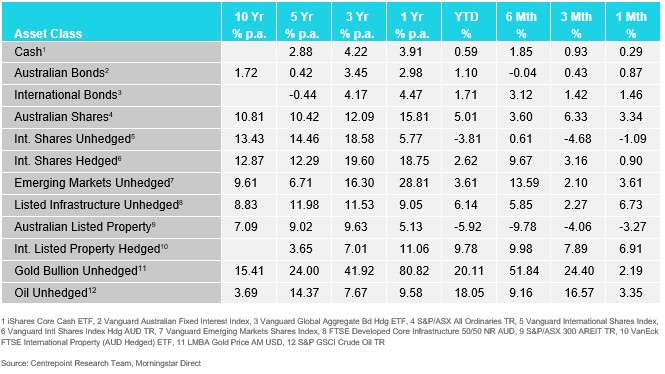
International equities slowed in February, with unhedged returns falling 1.09% and hedged returns rising 0.90% due to the weakening strength of the US dollar. These somewhat muted headline returns belie the interesting movements that occurred during the month.
There was a general rotation out of the sectors of the market that dominated much of 2025 such as technology and communication services and into more value-oriented sectors. Part of this rotation is due to investors choosing to invest in industrials, materials, and utilities stocks that are participating in the buildout of global AI infrastructure to access the AI trade through means outside of the Magnificent Seven. The energy sector also rose steadily throughout the month amid growing concerns of conflict between the US and Iran which ignited at the end of the month.
From a regional perspective Japan’s Nikkei 225 index was the strongest performing major share market, growing by 10.37% as the Japanese economy experienced a bull market driven by Prime Minister Takaichi’s push for reflation, fiscal stimulus and corporate governance reforms. The European Union’s Euro Stoxx 50 rose by 3.20% thanks to easing inflation and German fiscal support while the US S&P 500 retracted by 0.87% as investors rotated out of the Magnificent Seven.
Emerging markets also performed well in February, growing by 5.41% due to semiconductor companies in Taiwan and South Korea, TSMC, Samsung Electronics, and SK Hynix exhibiting strong growth.
Australian Equities
Australian equities rose by 3.34%, reaching a new all-time high on the last Friday of the month. This was despite a rate hike from the Reserve Bank of Australia (RBA) acting as a headwind at the start of the month. The materials sector was the biggest winner in February, rising by 8.98% off the back of a supportive global commodity market and the current demand for gold. Financials grew by 8.62% as the big four banks all revealed strong earnings for the quarter.
On the downside it was the health care sector which performed the worst in February, falling by 13.37%. This was primarily due to the largest company in the sector, CSL Limited, reporting underwhelming earnings results and announcing the sudden exit of its CEO. This announcement caused the stock price to slide 17.12% over the month to $146.65, down almost 50% from its price at the start of 2025.
Domestic and International Fixed Income
In February Australian bonds returned 0.87% with government bond yields falling despite the RBA’s hawkish rate hike to start the month. The effect of the rate hike diminished throughout the month due to global uncertainty around geopolitical tensions in the Middle East and the implications of AI-driven disruption in the labour market pushing investors to lower risk assets.
Global bonds also offered positive returns, rising 1.46%. US government bond yields fell further than in Australia as while they experienced the same global uncertainty pressures the Federal Reserve is less hawkish than the RBA due to the more moderate inflation in the United States. The German Bund and UK gilt yields also fell under the same pressures.
Australian Dollar
The Australian dollar continued to appreciate against the US dollar in February, appreciating by 2.43% over the month. This trend continues to be due to supportive commodity prices and US political uncertainty, with the latest RBA rate hike also contributing to demand for the Australian dollar over the US dollar.
Commodities – Gold and Oil
Oil prices grew by 3.35% in February. This increase was driven by the escalating tensions between the US and Iran and the hesitancy of the OPEC+ countries to increase their supply output to offset the rising prices. With the US-Iran conflict igniting on the 28th of February much of the impact of this conflict and its potential impact on trade through the Strait of Hormuz occurred after month end, with Crude Oil WTI Futures jumping 7.08% over the weekend following the end of February.
The price of gold continued to rise, growing by 2.19%. Gold prices continue to be supported by geopolitical uncertainty, a weakening US dollar, and demand from central banks, along with falling bond yields reducing the opportunity cost of holding the precious metal instead of other defensive assets.
Disclaimer
The information provided in this communication has been issued by Centrepoint Alliance Ltd and Ventura Investment Management Limited (AFSL 253045).
The information provided is general advice only has not taken into account your financial circumstances, needs or objectives. This publication should be viewed as an additional resource, not as your sole source of information. Where you are considering the acquisition, or possible acquisition, of a particular financial product, you should obtain a Product Disclosure for the relevant product before you make any decision to invest. Past performance does not necessarily indicate a financial product’s future performance. It is imperative that you seek advice from a registered professional financial adviser before making any investment decisions.
Whilst all care has been taken in the preparation of this material, no warranty is given in respect of the information provided and accordingly neither Centrepoint Alliance Ltd nor its related entities, guarantee the data or content contained herein to be accurate, complete or timely nor will they have any liability for its use or distribution.