
Market Review – March 2026

Key Themes:
- Australian and international equities retreated: The geopolitical shock from the conflict in the Middle East and the closure of the Strait of Hormuz resulted in a significant retreat in the equity market.
- Australian and international bond prices fell: The rise in the price of oil following the closure of the Strait of Hormuz increased inflation expectations globally, resulting in investors requiring higher yields on bonds.
- Australian dollar weakened against the US dollar: The US dollar’s status as a safe haven currency led to its value appreciating relative to the Australian dollar following the US/Iran conflict shock.
- Oil spiked and gold fell: The price of oil spiked following the closure of the Strait of Hormuz while the price of gold fell significantly from profit taking and lower demand.
How the different asset classes have fared
(As at 31st March)
International Equities
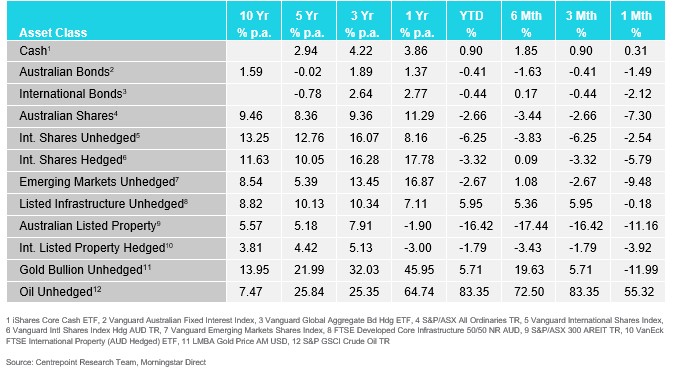
International equities retreated significantly in March, with unhedged returns falling by 2.54% and hedged returns falling by 5.79%. The key event that shaped the entire market in March was the US-Iran conflict and the continued uncertainty around how it will play out in the weeks or months to come. Following the initial strikes on Iran from the United States on the 28th of February the market fell in fear of how this could impact the global economy. This fear has only expanded as the conflict has progressed and Iran has shut down the Strait of Hormuz, disrupting the global oil trade in the region and sending shockwaves throughout the market.
While equity markets in general were hurt by the conflict, markets in countries and regions that are highly dependent on importing their fossil fuels were the worst hit by these developments. Japan’s Topix 100 index fell by 10.98% over the month as their reliance on imported energy as well as a falling yen raised inflation concerns, while Europe’s Euro Stoxx 50 declined by 6.97% due to rising energy prices and weakening economic momentum.
There were not many pockets of strength in March, but energy stocks were the main beneficiary of the conflict as the rising price of oil also drove up their stock price.
Australian Equities
Australian equities fell by 7.30% in March, just after reaching a new all-time high at the end of February. Australia was also hurt by the conflict in the Middle East as the resulting rise in the price of oil has increased inflation expectations and hurt the growth outlook for the market. The materials sector was the worst performing sector over the month, falling by 14.10% as miners faced softer demand from China and a decline in the price of gold.
There were only three sectors that finished the month in positive territory: consumer staples (0.25%), utilities (3.50%), and energy (18.51%). Consumer staples and utilities benefitted from the fear in the market as investors chose to move their investments into companies with more stable revenue streams. As with international equities, it was the conflict in the Middle East and the closure of the Strait of Hormuz that proved a boon to energy stocks as they stood to benefit from the rising price of oil globally.
Domestic and International Fixed Income
In March Australian bonds returned -1.49% as bond yields rose. With the current crisis in the Middle East and the rising price of oil, inflation expectations have been increasing throughout March. These expectations were cemented when the Reserve Bank of Australia (RBA) decided to increase the cash rate by 25 basis points at its March meeting, which was already being anticipated before the closure of the Strait of Hormuz. Both of these factors contributed to an increase in bond yields and the resulting fall in bond prices.
Bond prices faced a very similar situation internationally, as the rising price of oil and a split decision to maintain the current federal funds rate by the US Federal Reserve both contributed to rising bond yields, which led to bond prices falling by 2.12% in March.
Australian Dollar
The Australian dollar depreciated by 1.94% against the US dollar in March after appreciating over the first two months of the year and reaching its strongest level since January 2023. This sudden reversal can be attributed to the geopolitical shock coming out of the Middle East conflict driving global investors back to the safe haven US dollar, which had been losing favour since the tariff shock in April 2025.
Commodities – Gold and Oil
Oil prices spiked by 55.32% in March due to the direct impact of the closure of the Strait of Hormuz and attacks on oil infrastructure in the Middle East. This supply side shock has driven the price of oil above US$100 a barrel for the first time since a similar shock occurred in 2022 following the invasion of Ukraine by Russia. The full scale and impact of this disruption is still being debated as it largely depends on whether a deal can be negotiated between the US and Iran to halt the conflict and end the disruption.
The price of gold fell in March, declining by 11.99%. Gold is usually treated as a safe haven asset that benefits in times of crisis, but a number of factors converged to change the story this time. With the run up in the price of gold over the past year many investors had significant profits, and they used this event as a catalyst to try and cement these profits. This profit taking, combined with increasing inflation expectations and yields as well as a flight to the US dollar, led to lower demand for gold in March and its fall in price.
Disclaimer
The information provided in this communication has been issued by Centrepoint Alliance Ltd and Ventura Investment Management Limited (AFSL 253045).
The information provided is general advice only has not taken into account your financial circumstances, needs or objectives. This publication should be viewed as an additional resource, not as your sole source of information. Where you are considering the acquisition, or possible acquisition, of a particular financial product, you should obtain a Product Disclosure for the relevant product before you make any decision to invest. Past performance does not necessarily indicate a financial product’s future performance. It is imperative that you seek advice from a registered professional financial adviser before making any investment decisions.
Whilst all care has been taken in the preparation of this material, no warranty is given in respect of the information provided and accordingly neither Centrepoint Alliance Ltd nor its related entities, guarantee the data or content contained herein to be accurate, complete or timely nor will they have any liability for its use or distribution.